
What you're seeing
A wasp nest under the eaves?
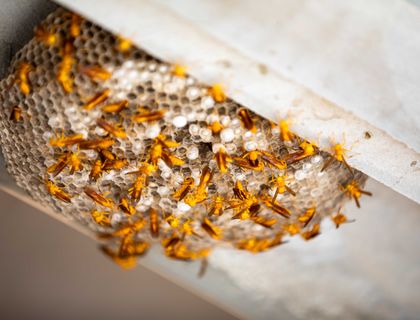
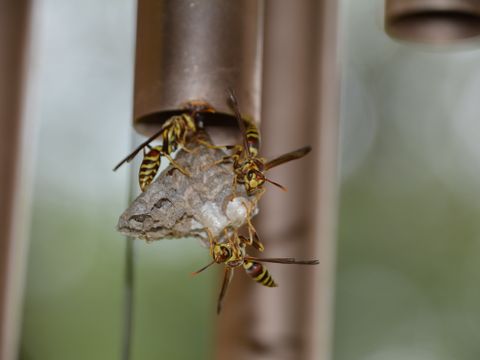
Umbrella-shaped paper nests under eaves, deck rails or porch ceilings are usually paper wasps. They defend the nest when it's bumped.
Act this weekWhat you're probably wondering
Need a pro? Call (855) 424-9709 to reach an independent local pest control company.
Most likely
Wasps, hornets and yellowjackets
Act this weekIt won't fix itself. Get it looked at soon.
Look closer
Check these next
A few minutes with a flashlight tells you a lot.
- 1
Open gray paper cells you can see from below.
- 2
Wasps landing on it and flying straight in.
- 3
Nests grow fast through summer.
- 4
Find the nest from a distance: under eaves, in a shed, in a bush, or a hole in the ground with insects flying in and out.
- 5
Note the size: golf ball, softball or bigger. Bigger nests mean more insects.
- 6
Watch the traffic. A steady stream in and out means an active nest.
Practical steps
What to do now
Do this now
- Keep people and pets away from the area.
- Use a different door if the nest is by an entrance.
- Note how big it is and how high up.
Avoid
- Don't knock it down or spray it from a ladder.
- Don't seal a nest inside a wall void; wasps chew inward.
Read the signs
If you notice more, here's what it usually means
When to call a pro
Call if it's near a door, a play area, or anyone has an allergy.
Your situation
Common situations with wasps, hornets and yellowjackets
Want the whole picture? Our wasps, hornets and yellowjackets guide covers how to tell, safe clean-up, prevention and when to call, based on EPA and CDC guidance · Download the PDF.
FAQ
Questions
A wasp nest under the eaves: what does it mean?
Umbrella-shaped paper nests under eaves, deck rails or porch ceilings are usually paper wasps. They defend the nest when it's bumped.
Will a wasp nest go away on its own?
Most wasp and yellowjacket nests die off in late fall and aren't reused. But until then, an active nest near the house is a sting risk.
Is it safe to remove a small nest myself?
Small, early-season nests in open spots carry less risk, but any nest near people, in the ground or in a wall is safer left to a pro.
Why are yellowjackets so aggressive in late summer?
Colonies are at their largest and food is scarcer, so they forage hard around trash, food and drinks.
What if they're honey bees?
Honey bees are valuable pollinators. A local beekeeper or bee removal service can often relocate them.
What's the difference between wasps, hornets and yellowjackets?
They're related. Yellowjackets are often ground or wall nesters; hornets build large paper nests; paper wasps build open, umbrella-shaped nests.
When are wasps most active?
Late summer and fall, when colonies are biggest.
Do wasps come back to the same nest?
Old nests usually aren't reused, but new queens may build nearby.
Is it safe to knock down a nest at night?
Even at night, a disturbed nest can sting. Large or hidden nests are a job for a pro.
How do I prevent wasp nests?
Seal gaps in eaves and siding, cover trash and food outdoors, and check for small nests in spring.
What if a nest is inside a wall?
Don't seal the hole; wasps may chew inward. Call a pro.
